
When Should a DSEAR Assessment Be Conducted? RIBA Plan of Work
Architects and design teams are increasingly involved in projects where dangerous substances (such as combustible dusts, flammable liquids, gases) are present. An issue we see is that DSEAR assessments are often commissioned too late in the project lifecycle, resulting in costly redesigns, programme delays, and avoidable safety risks.
This article explains how DSEAR should be integrated into the Royal Institute of British Architects (RIBA) Plan of Work and how this aligns with duties under the Construction (Design and Management) Regulations 2015 (CDM).
What is involved in a DSEAR Assessment?
A DSEAR assessment is not a compliance exercise, but should be a key consideration during the design. It typically includes the following elements:
Identify DSEAR Dangerous Substances - these are typically flammable gases, liquids, or vapours, combustible dusts, pressurised gases, substances corrosive to metal, or battery installations.
Hazardous Area Classification (HAC) - this is where areas of the site are classified into hazardous areas known as zones (or sometimes ATEX areas) where explosive atmospheres could exist. Within these zones, ignition sources must be controlled - usually with ATEX equipment. HAC drawings which show the zones in plan and elevation view should also be produced.
DSEAR Risk Assessment - wherever a dangerous substance is present, a DSEAR risk assessment is required. DSEAR has specific prescriptive requirements for what this should include in Regulation 5. The identified risks then must be reduced to As Low as Reasonably Practicable (ALARP).
DSEAR Verification - before a workplace is used for the first time, Regulation 7(4) o DSEAR requires that the overall explosion safety of the workplace is verified by a competent person.
When should I conduct a DSEAR Assessment?
RIBA Stage 0–1: Strategic Definition and Preparation
At this stage the project team should perform an initial DSEAR screening exercise to identify whether:
Flammable gases, liquids, vapours, or mists are present (including use of batteries)
Combustible dusts may be present
Existing hazardous areas may affect the project
This will then identify whether specialist input is required and provide early project risk register entries.
RIBA Stage 2 & 3: Concept Design and Spatial Coordination
These are the most important stages for early DSEAR input and where the most value is achieved. It aligns with the CDM requirements to eliminate, reduce, or control foreseeable risks at the earliest practical stage in the project. DSEAR can influence a number of key design decisions, such as:
Building layout
Ventilation strategy
Equipment location and specification
Access and maintenance requirements
Separation distances
A preliminary desktop-based DSEAR should be conducted in this stage to inform decision-making for the conceptual design.
RIBA Stage 4: Technical Design
During Stage 4 the DSEAR assessment should generally be finalised. The hazardous area classification can be confirmed, which informs where ATEX equipment is required, and what specification it should be. The risk assessment can also be completed, with the required control measures confirmed to reduce risks to ALARP.
The DSEAR assessment will provide:
Hazardous Area Classification (HAC) and Risk Assessment
Finalised HAC drawings showing the extent of any hazardous zones
Minimum ATEX equipment specification requirements for zoned areas
Ventilation requirements
Any fire and explosion mitigation measures required (e.g. sprinklers, blast walls, etc.)
Any other DSEAR compliance requirements
Failure to complete the DSEAR assessment to the required level of detail at this stage can lead to significant delays and additional costs if remedial actions are required after equipment has been ordered or installed.
RIBA Stage 5: Manufacturing & Construction
During RIBA Stage 5, the design should have been finalised - small changes may be made, but the impact of these on DSEAR should be considered. After equipment has been installed, commissioning typically occurs. This is when the DSEAR Verification should be conducted. DSEAR Verification acts as a pre-start up safety review and verifies that the installation has been properly designed and installed in line with the requirements of DSEAR.
RIBA Stages 6–7: Handover and Use
All DSEAR documentation should have been prepared and packaged up for handover to the facility operator. Any snagging or remedial actions should be tracked and closed out at this stage - this snagging list is typically the output of the DSEAR Verification.
The operator then assumes responsibility for ongoing DSEAR compliance. This includes inspection and maintenance of equipment and protection systems to ensure their continued effectiveness, appropriate DSEAR training for staff, implementing a suitable process safety management (PSM) framework, and an effective management of change (MoC) procedure.
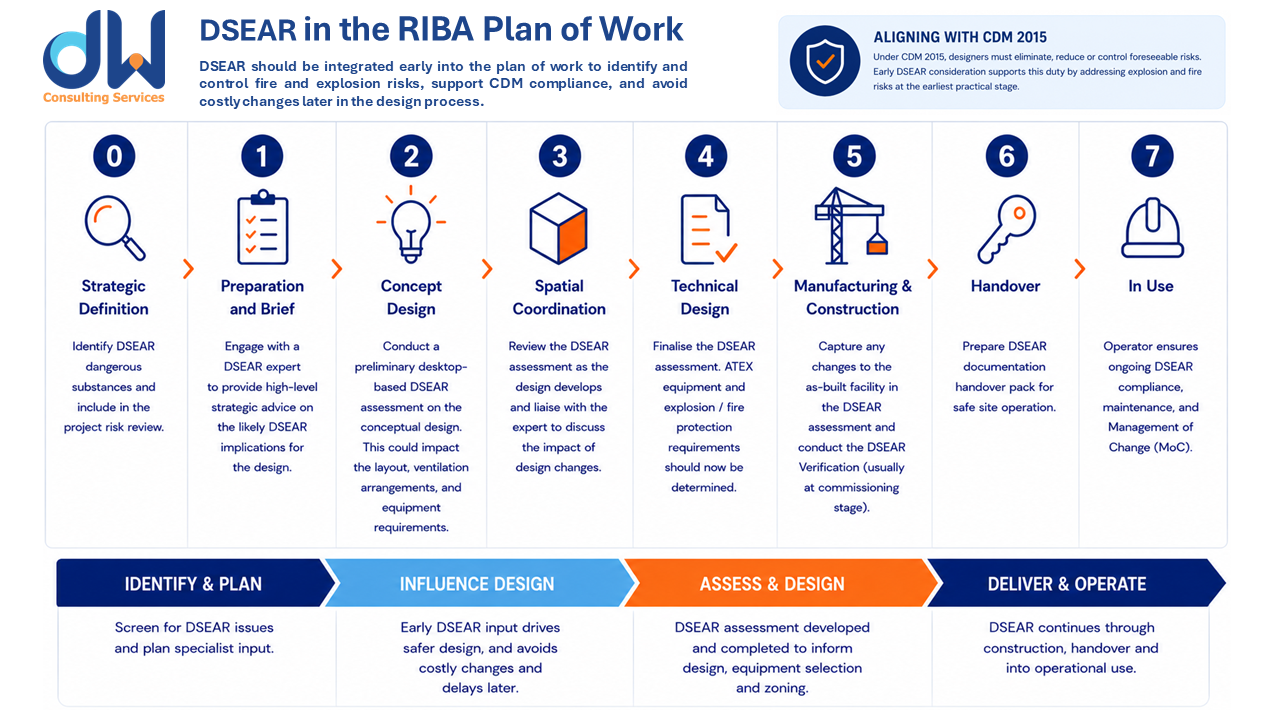
How DSEAR fits into the RIBA Stages as defined in the RIBA Plan of Work
Expert Support for DSEAR and ATEX
Our team supports clients across the UK with all aspects of DSEAR compliance, including:
If you need clarity or guidance, get in touch - we’re here to help.